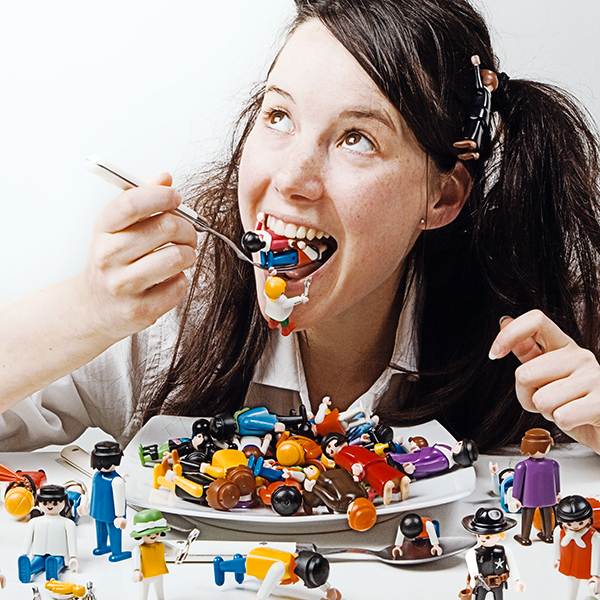
"This will never work !" It was the first words prononced by a few of skeptics people when they heard about Playmobil for the first time. Presented at theInternational Toy Fairin Nuremberg inFebruary 1974,threelittle men, an Indian,aknight andaworkerarenot welcomeby the profession.
"Toougly","irrelevant", they say. The reviews were unanimous, except for aDutch wholesalerpassingthe firstorder! Children arequicklyseducedwhenin the fall of1974, the firstPlaymobilboxesare appearing intoy stores.
The challenge was taken up ! in three years, salesincreased fromtwenty millionto more thanone hundred millionmarks.
The reason?The convergence ofcreativity,production tool,the risk assumedand demandforchildrenrole-play. Today, thePlaymobilfamilyhas more than2.3 billionsmallfellowmadesince 1974,150 million out of factorieseach year,650different charactersin the catalog (since inception3000), more than15,000accessories andverylittle competition-and counterfeiting-on the marketbythe molding technique.
Present inseventy countries,the turnover of Playmobil in 2009 was about474 millioneuros,placing it at the secondplace in EuropeafterLego. TheMuseum of Decorative Artshonored Playmobil fromDecember 2009 to May 2010, proof of its incontrovertible place in the toy world.
"The world ofPlaymobilisreal life,the life ofevery dayin which the childis reinventingits own universe"
Playmobil, it is a large family ofchildren, parentsand collectors!"Witha penetration rate of 90% in France,the brandfor children from3 to 10 yearsincludes amongits loyal customersat least fivemillion children".
"Honest brand, clear, authentic, which remainsfaithful to his promise, information presentedin its name,Playmobilwantsfunand educator"
Now that we have identified some trends, let's have a look at the two brands we chose : Lego and Playmobil. We will try to analyze their strategies, understand what gather and what oppose them, and work out how they deal with the new stakes we identified.
In her book Different–Escaping the Competitive Herd, Youngme Moon is wondering about how an alien coming from another planet could differentiate one brand of cereals from another. Actually, we, humans are so used to go through the different steps of the decision buying process that we are able to evaluate very quickly the different brands and to make a choice based on facts that could be very surprisingly insignificant for an alien.
What does make a brand different ? What could a company do to stand out from the other ones ?
This is a very complex but crucial question. With the brands multiplication and the products proliferation, being different has become a real stake for all the brands. Many brands just sell the same product : if we take the example of detergent, what is the difference between Ariel and Le Chat ? Their product have exactly the same functional value and generic attributes ! Aside from innovating and creating new products, brands have to find new ways to stand out and make their name shine.
Some of them do not hesitate to recycle old products and present them as new ones just by changing the packaging or the advertising. In Canada, Kraft Foods had made fun around this idea of “product renewing” : they are selling square biscuits called Shreddies, and in order to shed light on this products, they decided to advertised about the new diamond shape of Shreddies. The joke was that, as the biscuits were square, you just have to turn them to make them look diamond shape.
Beyond the joke, Shreddies case point out how unuseful can be the fact to change packaging and advertising or to “recycle” old products. So how to differentiate ? Is there a method to create brand differentiation ?
In order to understand this statement, we could take the example of Apple. What makes Apple so different from all the other phone and computer brands aside from technical characteristics ? The answer is simple : Apple succeeded in creating a whole universe around its products (they were the first to propose colored computersas we can see in their famous advertising "Beige", personalized iPods, special atmosphere in their shops…) and they stand out as the most reliable company on these markets. They succeeded in becoming the exception and not the rule, and this is what Thomson Dowson meant : a different brand is a one that brings consumer, not only what they need, but also what they want. They are rules breakers and stand out from the other as they propose more than just a functional value : they offer a unique experience and not just a product.
"People are being persuaded to spend money we don't have on things we don't need to create impressions that won't last on people we don't care about" - Tim Jackson
Lily Allen's lyrics sum up both the love we have of consuming and how it is engrained as a social norm
It is right that in developed nations, we live in an unprecendented world of super-consumption. According to recent studies, an individual is subjected to 500 to 2000 ads per day and these marketing campaigns whisper "buy-me, buy-me". In fact, we love to consume and it is almost a social norm.Here are somy lyrics from Lily Allen about this subject:
I am a weapon of massive consumption / It's not my fault / It's how I'm programmed to function.
However, it is obvious that we can not continue on this way because of a lot of social inequalities and it is sure that our planet can not stand this way of life !
Most of consumers don't have enough information, opportunity or motivation to make sustainable choices. Furthermore, even if they want to buy such products, they don't really know how to recognize and use them. Of course, there is some consumers who care abotu sustainability but they didn't do a lot (in terms of behaviour) in the last few years. So, this segment is still a "niche".
Step 2 - Start to experiment with new businesses models
Today, the success of firms is only measured in terms of financial results and there is nothing about environmental impact. But the resources or our planet are not unlimited and sooner or later governments will put a realistic price on dwindling environmental assets. So, follow the advice of starting to experiement this new business model which integrates this enviromental side.
Step 3 - Mainstream sustainability into everyday products
Innovation is the best way to get the right products to the market !
So, companies need to innovate and products need to be given real sustainability makeovers !
Step 4 - Get the price signals working properly
Why sustainable products are often more expensive ? Made the sustainable products cheaper and create a real benefit for the consumer.
Step 5 - Get the communication right
Brands need to put themselves into the head of someone who is not hardwired to be green. Yet, the duality of benefice is important for consumer: good price and green / looks good and green / good for health and green and so on. Try to build sustainability into mainstream brands as much as possible because people already recognise and trust them.
Step 6 - Don't wait for the consumer to demand sustainability
In the coming years, the sustainable trend will drive the market. So, seize this opportunity to make money by accelerating the transition to a more sustainable world.
To conclude, we can say that brands and businesses need to prepare for a sustainable future: a world where they provide goods and services that have some social and environmental benefits. By acting as networked and connected agents of transformative changen brands have the power to make this world a reality ....
Successful brand building is both a science and an art. The stakes of brand building are crucial, but it often relies on intangible elements that are very hard to define, and even harder to be worked on.
The whole branding blogosphere is buzzing with questions such as “how to reinforce a brand ?” “How to build trust in a brand ?” “What does make a brand successful ?”
Well, there is no secret or magical recipe, but there are some key-ingredients that seem to be found in every successful brand. These elements need a specific attention and we will try to understand how to work on them.
The first ingredient to the brand-building recipe would be brand awareness. How can a brand be successful if it is not known as widely as possible ? Brand awareness can be easily worked on through all form of marketing communication : advertising (TV, radio, posters…), social media interaction, community building, beach or ski station tours, animations in shop… depending on the targeted customers. Renewing is also a way to build awareness (new formulations, new locations…) in order to reach always more potential customers.
Now that the brand is well spread and known among customers, it has to appeal them. How can we define appeal ? What does appeal people to a brand ? I guess that what makes a brand appealing is more or less what makes a person appealing : honesty, authenticity, originality, integrity, passion, sensuality, mystery… All this elements intrinsic to the core value of the brand make it possible to create a relationship with customers and so to appeal them.
This leads us to the following key-element in brand building : emotion. Why do we buy a brand in particular ? Mainly because the imagery it conveys matches whether the image we have of ourselves whether the way we would like to be. Therefore, buying a particular brand could be more an emotional decision than a rational one. Brands speaks to our inner personality this is why, with a precise and efficient targeting coupled with a deep understanding of the core values wanted by the target, a brand should succeed in moving and appealing a customer.
Through awareness, appeal and emotion, a brand can succeed in creating a real relationship with its customers. Once this relationship is created, the brand needs to lead its customer to trust it. How to build something as intangible as trust ? Well, a first way would be through customer satisfaction and experience : if they are satisfied, if the product and the brand in general fulfill its promises, the customers will be disposed to trust the brand and so buy it again.
Melted together, these four ingredients should enable a brand to grow successfully.
We did not meant to be exhaustive in all the criteria that make it possible to build a strong brand, we tried to find out which were the greatest and newest tendencies seen on the different branding blogs. Which stroke us the most was that it seems that companies and brands are willing to focus on the relationships they have with their customers, and to gain their love and their trust, which is probably the best way to gain their wallet.
Let’s start to talk about the new trend in community development and social media expansion in our branding world today.
As we said before, social media are becoming more and more present in our everyday lives. It’s important for a company to be present on Internet and to develop its actions on Social Media.
Some companies do it pretty well as mentioned on this website:
This article will show you 10 of the smartest big brands in Social Media while giving you examples of what they do and where.
Let’s take some of the examples mentioned in the article and see why are the brands powerful in social media.
The first good example is Blendtec. They started a video campaign on YouTube called “Will it blend?” where you could see Blendtec CEO, Tom Dickson, trying to blend objects in one of the company’s blender.
This was a low cost campaign and it contributes to a five-fold increase in sales.
I think that what Blendtec did was a very good use of the social media YouTube. Everyone knows YouTube; it’s the biggest video search engine on Internet so by using this social media, it was a good way for Blendtec to get many customers see their videos.
What they do well is that it was funny and original videos that were only a few minutes long so it wasn’t boring and people were enjoying the videos. It demystified the CEO by presenting him doing something funny. It also enabled the company to show how effective were their blenders; because it is not obvious that an iPhone can actually be blend and in the video, you can see that it can!
Another good example is Starbucks. They actually created a new website called “My Starbucks idea” where people could submit their suggestions and the most popular ones were highlighted and reviewed.
It enabled the company to get consumers’ impressions and feedbacks. I reckon that this was a good move by Starbucks because it gave the impression to the consumers that their opinion counts and that the company is listening to them. Customers like to be taking into account; they feel closer to the company and they are more likely to by their product.
Moreover, they even created a blog called “Ideas in action” where people could actually see the process of the changes suggested: a good way to show customers that their ideas were useful and even put into place.
And the last example that I can name is the Ford’s one. Ford did an internal gaffe where their legal department sent out cease and desist letters to forum users using Ford trademarks. People were outraged. To repair this problem, Scott Monty, Ford’s community manager, was able to solve the problem quickly and let people know the true story and they were informed of every steps of the way through Twitter.
This was a very good way to handle their crisis. It showed that Ford was telling the truth and that they wanted to inform their customers. Thanks to the social media Twitter, Ford was able to inform in real-time the consumers and this transparency and constant information were really well received.
To conclude, we can say that they are many ways to use social media. What we can say is that social media are incontrovertible nowadays. Everyone uses it and everything happens there. It’s an important way of communication and companies need to be there! The good thing is that any information is available anywhere in the world at any moment. It gives us the possibility of being closer to the company by knowing what they do.
Nowadays, a trend which is in vogue is all about "sustainability". In fact, most of companies are now thinking to be eco-friendly, sustainable and respectable for the environment. So, on internet, we can find a lot of articles on different blogs which concern this theme and more precisely "the recycling". It is right that since many years we used to recycle some stuff but now more and more things can be recycled. according to the articles (http://www.thegoodhuman.com/2011/10/18/ten-things-you-could-recycle/), we can recycle old cars, cell phone, wardrobe, crayons, toothbrush, eyeglasses, promdress, old socks, air, yoga mats, old batteries or aluminium cans.
Some brands as Evian or Coca-Cola made advertising about this subject.
Evian communicated about its new bottler which is lighter in plastic and easier to crush.
Coca Cola encourages its customer to recycle its bottle and to become the "recycling king" !
Personnally, I try to recycle as much as possible because I think it is something easy to do and it could be very helpful. For example, I have 2 garbage can in my small student's flat, I use a lot of rough copy for my homework or I give my plastic cork to an association who recycle them in order to product wheelchair for people in need. Another thing that I found very interesting during my trip to USA was the "garage sell". On saturday, people open their garage where they have stocked all things they did not want anymore. And they sell it to people for a really modest amount. It is an another way to give a second life to your products !
Before auditing our two main brands: Lego and Playmobil, we started to look at different blog on branding in order to identify key issues regarding branding strategy and brand management today.
Most of the branding blogs were dealing with brand identity, community development, innovation and future developments, customer relationship management, advertising and communication, social media, responsibility and engagement, building trust and providing loyalty via a brand, etc.
We decided to focus on three main trends in this blog and we will present them to you through our articles.
The first topic that we chose is the brand identity issue. As a matter of fact, nowadays, it is more and more important for a brand to have a strong identity. We are living in a world ruled by brands; they are everywhere. In order to be powerful, brands need to differentiate from the others and they can do so through their values, their activities, their logo, their colour, their image, their ambassadors and so on… In the articles related to this topics, we will try to understand how brands manage to build a strong identity, how do they build a trusted relation with their customers and how do they achieve to make them become loyal.
The second issue that we decided to deal with is responsibility and engagement. Sustainable marketing is becoming a new trend. People are getting more and more aware that the pollution is growing and that keeping our environment healthy is primordial. Brands have to follow this trend in order to act as a more responsible company. We will show you, through some of our articles, how brands are becoming each day more sustainable and what do they do in order to do so.
The third and last branding trend that we have selected for this blog is community development and social media expansion. Social media are becoming more and more present in our lives; everybody use them so it is important for brands to be part of them and to use them to promote themselves. Moreover, people are gathering together in order to build communities that identify themselves through same ideas or activities. It is getting more and more important for some people who only identify themselves through these communities. Brands need to be aware of this trend and start to develop their own communities of people or customers. We will try to understand how they do so.
So, everyone, let’s get it started! Enjoy your time while reading us!!
Almost everyone had to answer this crucial question during his childhood, and it may have turned into an endless and passionate debate.
As a matter of fact, these two brands succeeded in creating a real community of players through very efficient branding and marketing strategies.
How do they manage to do so ? What are the main differences in their strategies ? How do they react to the new stakes of consumption ? Did they succeeded to keep in touch with the new trends in term of brand management ?
We will try to answer all these questions through this blog, first by identifying the key issues in term of branding, and then by opposing Lego and Playmobil’s strategies on these particular issues.
Feel free to comment, interact and ask questions, and above all, HAVE FUN !